You can incorporate a Singapore company from overseas without relocating, subject to local registration requirements. A registered corporate service provider (CSP) can file on your behalf.
The handover still depends on you. Your provider can reserve the name, prepare documents and file with ACRA. You must supply ownership information, required consents and acceptable identity evidence. A clear division of responsibilities matters before filing begins.
Registered CSPs have anti-money-laundering and beneficial-owner obligations under the Corporate Service Providers Act. For remote incorporation, ACRA's guidelines generally require a live video call with a qualifying director, member or representative. The call is only part of due diligence.
In this blog, we explain the handover for incorporating a Singapore company without relocating. We cover documents, decisions, responsibilities, ACRA fees and the items that remain open afterwards.
Table of Contents
Can You Incorporate a Singapore Company from Overseas Without Relocating?
Yes, an overseas founder can pursue incorporation without relocating, subject to registration and local-residency requirements. ACRA requires foreigners to engage a corporate service provider to reserve a name and register a business structure. Confirm that your chosen provider can complete your particular case remotely. The requirement does not itself establish Singapore Setup Company's registration status.
Registration and relocation are separate steps. Incorporation gives you no immigration permission. If you move to Singapore to run the business, you need an appropriate work pass. Banking, licensing and individual circumstances may introduce separate constraints.
What Should You and Your Provider Agree Before Filing?
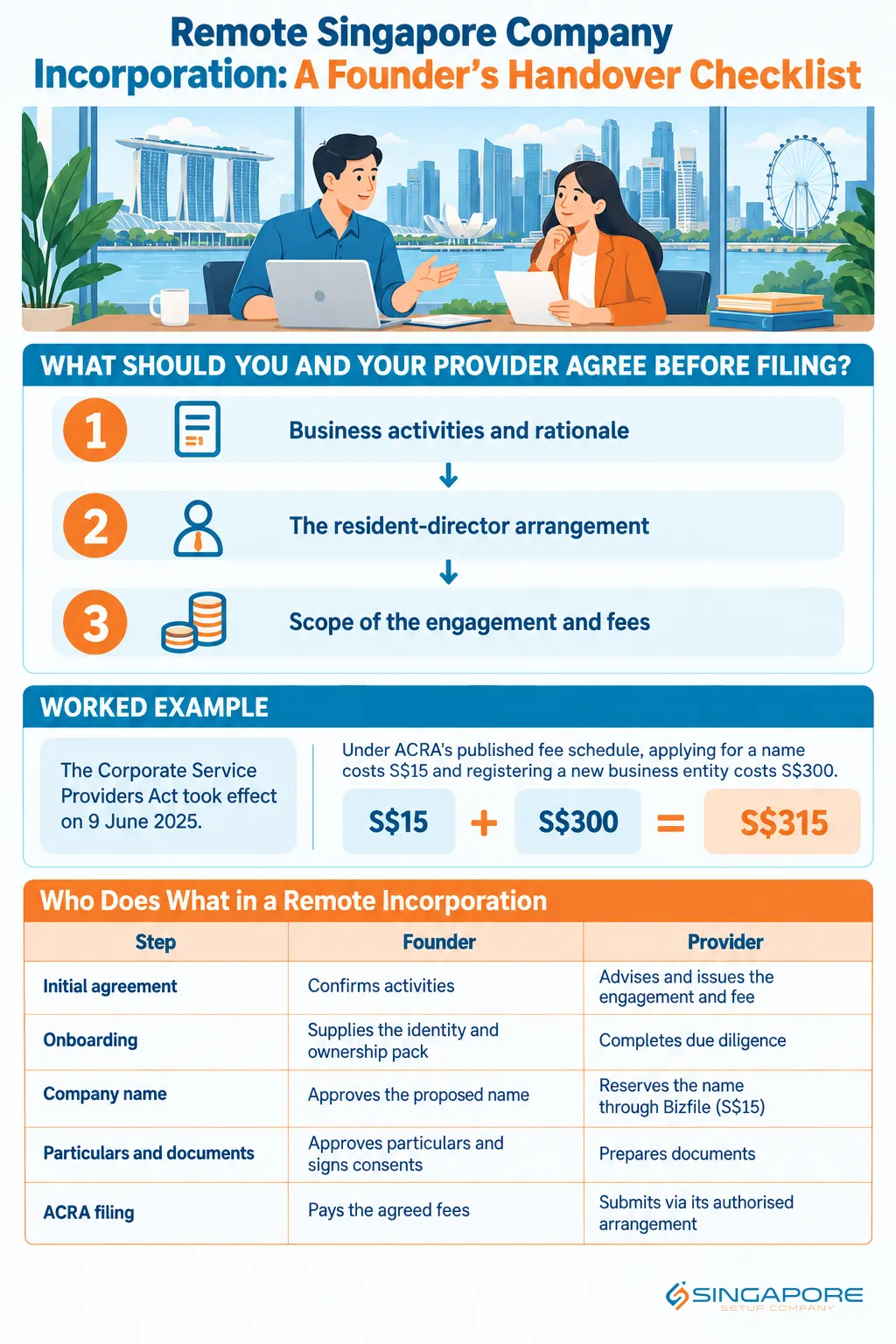
Four matters should be agreed before taking an incorporation instruction: activities, ownership, the resident-director arrangement and engagement scope. Agree the sequence and responsibility split with your provider before work starts.
Ownership: Identify the proposed shareholders and the people who ultimately control the company. Explain any corporate layers so your provider can determine what evidence it needs.
1. Business activities and rationale
You and your provider should agree what the company will actually do, which countries its customers and suppliers sit in, and why the Singapore entity makes sense. This drives the activity codes filed with ACRA and the proportionate due-diligence questions that follow.
2. The resident-director arrangement
A local company must have at least one director who is ordinarily resident in Singapore at registration. If you have no local partner, discuss whether a nominee arrangement is available. Confirm its due diligence requirements and terms separately. A nominee holds real director duties, and a registered CSP arranging such appointments must assess the person's fitness and propriety.
3. Scope of the engagement and fees
Ask what the fee covers and, just as importantly, what it does not. Incorporation, company secretarial work, the registered office and accounting are often scoped separately from bank introductions, licences, tax structuring or immigration advice. A written breakdown prevents surprises at the filing stage.
Registering a Company vs Relocating to Singapore
| Aspect | Company registration | Relocating to Singapore |
|---|---|---|
| What it is | An ACRA filing that creates a legal entity | An immigration step to live and work here |
| Who handles it | You and your registered corporate service provider | You and the Ministry of Manpower / Immigration & Checkpoints Authority |
| Key requirement | Resident director, registered office, filing fees | An appropriate work pass, based on your own profile |
| Must you relocate? | No | Yes, by definition |
Which Documents Must a Foreign Founder Prepare?
To incorporate a Singapore company from overseas, prepare an identity and ownership pack for your provider's onboarding checks. A passport is only a starting point. Your provider should explain its checklist, acceptable alternatives and the information needed for due diligence.
1. What each individual supplies
Your provider may request passport copies, residential-address evidence and identification details for relevant individuals. It may also request tax-residency information, the business rationale and source-of-funds details, depending on risk. Confirm its requirements and acceptable alternatives. Any policy on the age of address evidence is a provider standard, not a universal statutory expiry rule.
2. What a corporate shareholder adds
A corporate shareholder may need to provide registry records, constitutional documents and directors' and ownership information. An authorising resolution and an ownership chart identifying ultimate controllers may also be requested. Confirm requirements, translations and alternatives with your provider; this is not a universal statutory checklist.
3. The discrepancies practitioners look for first
Experienced practitioners look first for discrepancies in identity and ownership information. Examples include mismatched address evidence, expired identification, inconsistent transliterations and incomplete ownership charts. Material discrepancies should be resolved before filing. Ask your provider how it reviews issues and what replacement evidence it accepts.
Who Does What in a Remote Incorporation
| Step | Founder | Provider |
|---|---|---|
| Initial agreement | Confirms activities, ownership, director arrangement and scope | Advises and issues the engagement and fee breakdown |
| Onboarding | Supplies the identity and ownership pack | Completes due diligence, screening and beneficial-owner checks |
| Company name | Approves the proposed name | Reserves the name through Bizfile (S$15) |
| Particulars and documents | Approves particulars and signs consents | Prepares documents, constitution and officer details |
| ACRA filing | Pays the agreed fees | Submits via its authorised arrangement (S$300) |
| After approval | Reviews the deliverables | Delivers the UEN, incorporation notice and Business Profile |
How Is Your Identity Verified When You Never Come to Singapore?
Identity verification and signing are separate steps. Confirm the methods and acceptable execution arrangements with your provider.
ACRA's guidelines generally require a live video call for remote incorporation. The call must involve a proposed director who is not a nominee director, a proposed member holding at least 50% of voting rights, or an individual authorised representative of such a member that is a legal person. The guidelines provide an exception when the customer is represented in the transaction by an advocate or solicitor or a public accountant. The call verifies identity and authority; it does not complete due diligence by itself.
Notarised or apostilled documents can support verification but do not replace the provider's risk assessment. Additional evidence may be requested. For signing, check each document's execution requirements and whether electronic signatures are accepted. Required consents and document-specific formalities still apply.
The Corporate Service Providers Act took effect on 9 June 2025. Registered CSPs have customer and beneficial-owner verification, monitoring and record-keeping obligations. Bizfile replaced the old BizFile+ portal in December 2024. These general obligations do not establish any particular firm's controls or registration status.
Current ACRA Fees for Company Registration (2026)
| eService | Fee |
|---|---|
| Apply for a new business entity name | S$15 |
| Register a new business entity | S$300 |
| File annual returns | S$60 |
What Happens at the ACRA Filing Stage?
Once due diligence is clear, the filing itself follows a fixed sequence. The steps are straightforward, but each one has decisions attached that you, not the provider, must settle.
1. Name reservation and registration
A business name must be reserved before a local company is registered — this step cannot be skipped. Under ACRA's published fee schedule, applying for a name costs S$15 and registering a new business entity costs S$300. Some applications require additional review or referral. Processing times depend on the application.
2. The particulars locked before filing
Before submission, settle these company particulars:
- Activities and shareholders
- Share classes, currency, issued shares and paid-up capital
- An ordinarily resident director
- A Singapore registered office
- The constitution
- The financial year end
The registered office must be a Singapore address; companies must continue to make company records available for inspection in accordance with the law.
A company secretary must be appointed within six months of registration, and a sole director cannot also act as secretary.
3. Filing, endorsements and what you receive
An authorised provider can submit the application through its Bizfile arrangement. Confirm its registration, filing arrangements and responsibilities before engagement. If a CSP files, position-holder endorsements in Bizfile are not required. Other required consents and signatures still apply. The constitution must be submitted, and subscribers must sign the retained copy; check the acceptable execution method.
On approval, ACRA provides a notice of incorporation, a UEN and access to a free Business Profile. Download the profile within ACRA's specified period. A Certificate Confirming Registration or Incorporation of Entity is a separate information product. Confirm whether obtaining it and delivering other documents are included in your engagement.
Open Items After Incorporation
| Item | What it involves | Usually handled by |
|---|---|---|
| Corporate bank account | Bank identity checks and possibly in-person steps | Founder, often with a provider introduction |
| Licences and permits | Depends on the activity and its regulator | Founder or a specialist |
| Work pass | Check the applicable requirements before working in Singapore, including on a short-term assignment | Immigration specialist |
| Tax residence | Where the business is controlled and managed | Founder with a tax adviser |
| Registers and annual filings | ACRA filings and register maintenance | Provider under a secretarial engagement |
What Stays Open After Your Company Is Incorporated?
Incorporation is not the end of the journey. Agree who will handle any remaining items.
Banking: incorporation does not itself complete bank onboarding. Banks apply their own identity checks, and some routes may involve physical presence or certified documents. Timing and available remote routes vary between banks, so plan the account as a separate workstream.
Licences and permits: some activities require licences or permits before operations begin, and the regulator depends on the trade. Opening a gourmet ice cream shop in Singapore involves food-licensing considerations, for example, while a blockchain-based supply chain management business raises a different set of regulatory questions. Requirements and sequencing depend on the activity and the applicable regulator.
Immigration and tax: incorporation grants no right to work in Singapore. If you plan to work there, check the applicable pass requirements with a specialist. On tax, the Inland Revenue Authority of Singapore (IRAS) determines a company's residence by where its business is controlled and managed — a Singapore incorporation alone does not make the company Singapore tax-resident.
Ongoing compliance: registers such as the register of registrable controllers, and annual filings — currently S$60 to file an annual return under ACRA's fee schedule — continue after incorporation, subject to the applicable exemptions and deadlines. Confirm applicable exemptions and who is contractually responsible for the registers and filings. Raise open items with your provider at the start, or contact us to discuss your plans.
Conclusion
Remote incorporation depends on a clear handover. You supply documents and make the company decisions; a qualified provider handles the agreed filing work. Confirm the provider's status, scope, process and deliverables before engaging it.
Banking, licences, immigration and tax residence remain separate questions. Contact Singapore Setup Company to discuss your plans and the services available for your circumstances.
Ready to Incorporate Your Singapore Company from Overseas?
Share your business activities, ownership plan and resident-director needs with our team, and we can discuss the documents, decisions and filings relevant to your circumstances.
Frequently Asked Questions
Yes, you may be able to incorporate without ever visiting Singapore or relocating, provided local requirements are met and your provider can handle your particular case remotely. Foreigners must engage a CSP to reserve the name and register the business. ACRA generally requires a live video call with a qualifying non-nominee director, member or representative, subject to an exception. A bank may still require an in-person visit; licensing and immigration may also impose separate requirements.
Yes. A local company must appoint at least one director who is ordinarily resident in Singapore at registration. If you have no local partner, ask whether a nominee arrangement is available and confirm its terms. A nominee director has real director duties.
Under ACRA's published fee schedule, current as at 2026, a name application costs S$15 and registering a new business entity costs S$300. Filing an annual return later costs S$60.
Not by itself. IRAS determines a company's residence by where its business is controlled and managed, which depends on the facts and can change from year to year. Take advice on your own structure.
Within six months of registration. A sole director cannot also act as the company's secretary, so an overseas founder who is the only director will need someone else in the role. Confirm whether secretarial service is included in your engagement.

Singapore Setup Company
Author
Singapore Setup Company is a Singapore corporate services provider that guides local and foreign entrepreneurs through setting up and running a company in Singapore.