
Should you close your first accounts in the December you incorporate, or carry the opening period into the following year? It is one of the earliest decisions after Singapore company incorporation, and the financial year end you record drives everything that follows. Your tax Years of Assessment, ACRA filing calendar and start-up exemption window all hang off that single date.
A company incorporated on 15 November 2024, for instance, may lawfully choose 31 December 2024, 31 March 2025 or 31 December 2025 as its first financial year end. All three periods are under 18 months. A longer first financial year requires the Registrar's approval. The shortest option, though, can saddle a delayed launch with a near-empty set of statutory accounts.
In practice, founders often incorporate late in the year to open a corporate bank account, sign contracts or support a work pass, and only begin invoicing months later. The closing date you choose then decides whether that quiet spell becomes its own accounting close or folds into a longer opening period. The wrong default is easy to record and slow to unwind.
This guide explains the permissible dates, a practical decision sequence, and the tax and filing calendar each option produces. We use a hypothetical 15 November 2024 incorporation as a worked example, which you can map onto your own incorporation date. In this blog, we discuss how to choose your company's first financial year end in Singapore.
Table of Contents
What Rules Govern a Singapore Company's First Financial Year End?
Two rules govern the choice: ACRA records the financial year end (FYE) at incorporation, and the Companies Act caps the first financial year at 18 months unless the Registrar approves otherwise. The FYE is simply the closing date of your company's accounting period. You enter it when you register a local company using Bizfile, alongside details such as the registered office address and company email.
The Accounting and Corporate Regulatory Authority (ACRA) collects the date at registration. The Inland Revenue Authority of Singapore (IRAS) uses it to determine basis periods and Years of Assessment (YA). In broad terms, the YA is the year following the accounting period that produced the profit being assessed.
Your Singapore company first financial year end is therefore more than a form field. You can choose a first closing date within 18 months. A longer opening period requires the Registrar's approval.
For the 15 November 2024 incorporation used throughout this article, a hypothetical date rather than a client record, three dates are possible. All three keep the opening period inside 18 months, so none requires the Registrar's approval.
The rules are also industry-neutral. Creating a gourmet ice cream shop business in Singapore involves exactly the same FYE decisions as incorporating a technology consultancy; only the calendars of the parties around you differ.
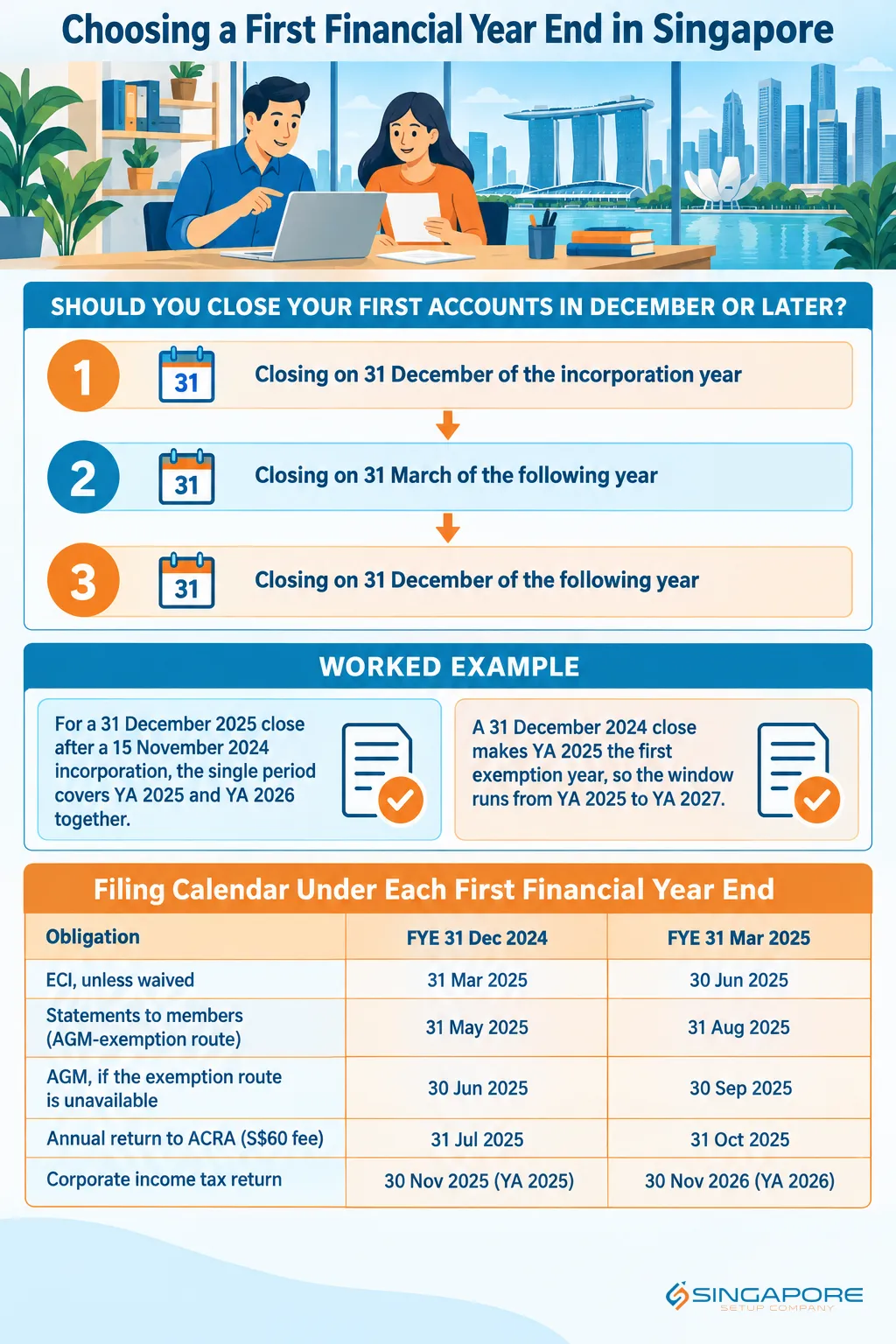
Should You Close Your First Accounts in December or Later?
For a standalone company launching the following year, consider closing on 31 December of that later year. It avoids a separate, near-empty first close in the incorporation year. Group, investor or lender requirements may point to another date.
First check when trading will start. Then check external reporting requirements and the expected first profitable period. Request itemised quotations for comparable periods, and confirm their inclusions and exclusions before comparing costs.
1. Closing on 31 December of the incorporation year
This gives a very short opening period, about six weeks for a mid-November incorporation. It suits a subsidiary whose parent, investors or financing arrangements demand an immediate December close, because it aligns the Singapore entity with the group calendar. The trade-off is usually a separate statutory accounting close, with a first set of accounts and statement circulation or an AGM; eligible dormant relevant companies may be exempt from those requirements, but must still file an annual return and any required tax return.
2. Closing on 31 March of the following year
This produces an opening period of roughly four-and-a-half months. It is the natural fit where a wider group reports on a March year end, since consolidation prefers matching periods. It also starts the company's tax clock one YA later than a December close, which can stretch the start-up exemption into an extra calendar year.
3. Closing on 31 December of the following year
This gives an opening period of about thirteen-and-a-half months. For a delayed-launch standalone company, this date may be worth shortlisting first. It avoids a near-empty first accounting close. The longer period does not remove any bookkeeping from incorporation, and it must be reported across two tax YAs.
Permissible First Financial Year Ends for a 15 November Incorporation
| Proposed FYE | Opening period | Approximate length | Registrar approval |
|---|---|---|---|
| 31 December 2024 | 15 Nov 2024 to 31 Dec 2024 | About 1.5 months | Not required, period within 18 months |
| 31 March 2025 | 15 Nov 2024 to 31 Mar 2025 | About 4.5 months | Not required, period within 18 months |
| 31 December 2025 | 15 Nov 2024 to 31 Dec 2025 | About 13.5 months | Not required, period within 18 months |
How Is a First Financial Year of More Than 12 Months Taxed?
A Singapore first financial year of more than 12 months is taxed across two consecutive Years of Assessment rather than one. IRAS treats a long opening accounting period as spanning both YAs. For a 31 December 2025 close after a 15 November 2024 incorporation, the single period covers YA 2025 and YA 2026 together.
Income and expenses are attributed to each YA directly where the records identify them. Where they cannot be identified, IRAS guidance for newly incorporated companies allows time apportionment across the two years. Incorporation costs, bank charges and pre-launch spending must still be recorded from day one, so a quiet first trading year does not shorten your record-keeping.
Estimated Chargeable Income (ECI) is generally due within three months of the financial year end. The usual ECI waiver requires annual revenue of no more than S$5 million and nil ECI. Measure ECI before the relevant tax exemption. Other specifically exempt categories exist. For the long first period, the ECI filing covers the computations for both YA 2025 and YA 2026 at once.
The annual return of income follows the standard cycle. Companies must generally file their YA 2026 Corporate Income Tax Return by 30 November 2026. An IRAS filing waiver may apply, including for eligible dormant companies. A loss or lack of trading alone does not automatically waive filing.
For the December 2024 close, the YA 2025 return is due by 30 November 2025. This assumes the company commenced business or received income in 2024. For the long December 2025 close, the first return is due by 30 November 2026. It reports the amounts attributable to YA 2025 and YA 2026. Check IRAS notices, first-return conditions, waivers and any extensions.
Simplified forms have revenue limits and other eligibility conditions. A qualifying company can file Form C-S with annual revenue of S$5 million or below. Form C-S (Lite) is available to qualifying companies with revenue of S$200,000 or below. Other companies file Form C with the required supporting documents.
A practical caution: no revenue does not automatically make a company dormant. Assess its activities under the applicable dormancy rules. Pre-commencement expenditure still needs tax classification. Assess the position each year rather than assuming filings can be skipped.
Start-Up Exemption Window Under Each First Financial Year End
| First FYE | First YA covered | Exemption window | Practical effect |
|---|---|---|---|
| 31 Dec 2024 | YA 2025 | YA 2025 to YA 2027 | Window starts immediately after incorporation |
| 31 Mar 2025 | YA 2026 | YA 2026 to YA 2028 | Window starts one year later and reaches YA 2028 |
| 31 Dec 2025 (long period) | YA 2025 and YA 2026 | YA 2025 to YA 2027 | One set of accounts spans two YAs |
How Does Your Financial Year End Shape the Start-Up Tax Exemption?
It decides which tax years fall inside the scheme's three-year window. The tax exemption scheme for new start-up companies exempts 75% of the first S$100,000 of normal chargeable income and 50% of the next S$100,000 in each qualifying year. The balance is taxed at the 17% corporate income tax rate.
The exemption tests are trade-neutral in structure. A founder creating a clothing business in Singapore faces the same YA windows as a software company; only the industry exclusions and shareholding profile differ.
1. How the three-year clock runs
The scheme covers your first three consecutive YAs, not your first three profitable ones. IRAS guidance confirms that a YA with no income or a loss still uses up one year of the window. After the three YAs pass, later profits receive only the partial tax exemption.
2. Who qualifies
Eligibility is tested for each YA. The company must be incorporated in Singapore and be tax resident there for that YA. Throughout its basis period, no more than 20 shareholders must directly and beneficially hold the total share capital. Either all shareholders must be individuals, or at least one individual must hold at least 10% of the issued ordinary shares. A wholly corporate-owned subsidiary fails the individual-shareholder condition. Companies whose principal activity is investment holding are excluded. So are companies undertaking property development for sale, investment or both.
3. What your closing date changes
A 31 December 2024 close makes YA 2025 the first exemption year, so the window runs from YA 2025 to YA 2027. The long 31 December 2025 close also starts the window at YA 2025, because the single long period spans YA 2025 and YA 2026. A 31 March 2025 close starts the window at YA 2026. It can preserve relief for YA 2028 that a December close cannot reach, subject to eligibility. The potential benefit is a proposed interpretation, not a net saving. Compare actual basis periods, including April–December 2027, and apply relevant rebates. Confirm the assumptions through tax review. A long first period does not by itself disqualify a company from the scheme.
Illustrative Statutory Tax: Start-Up Versus Partial Exemption
| Normal chargeable income | With start-up exemption | With partial exemption only | Pre-rebate difference |
|---|---|---|---|
| S$100,000 | S$4,250 | S$8,075 | S$3,825 |
| S$300,000 | S$29,750 | S$33,575 | S$3,825 |
Filing Calendar Under Each First Financial Year End
| Obligation | FYE 31 Dec 2024 | FYE 31 Mar 2025 | FYE 31 Dec 2025 |
|---|---|---|---|
| ECI, unless waived | 31 Mar 2025 | 30 Jun 2025 | 31 Mar 2026, covering YA 2025 and YA 2026 |
| Statements to members (AGM-exemption route) | 31 May 2025 | 31 Aug 2025 | 31 May 2026 |
| AGM, if the exemption route is unavailable | 30 Jun 2025 | 30 Sep 2025 | 30 Jun 2026 |
| Annual return to ACRA (S$60 fee) | 31 Jul 2025 | 31 Oct 2025 | 31 Jul 2026 |
| Corporate income tax return | 30 Nov 2025 (YA 2025) | 30 Nov 2026 (YA 2026) | 30 Nov 2026 (YA 2025 and YA 2026) |
What ACRA Deadlines Follow Each Financial Year End?
For a non-listed local company with no overseas branch-register adjustment, the Annual General Meeting (AGM) generally falls due six months after the FYE and the annual return seven months after. Filing annual returns costs S$60 under ACRA's current company fee schedule. This is a statutory fee, not a professional service quotation. Additional charges or penalties may apply.
A private company can avoid holding an AGM by sending full financial statements to every member within five months of the FYE. Members and an auditor may retain meeting-request rights. Check eligibility, any requests and extensions before relying on this route. There is no separate universal accounts-preparation deadline; the accounts simply must be ready for whichever circulation, meeting and filing dates apply.
An experienced corporate services team will aim to have draft accounts complete well before the ECI date, so the estimate is filed on reconciled figures. That is a working practice rather than a statutory rule.
Changing the date later does not reset every clock. Goods and Services Tax (GST) registration continues to follow the retrospective calendar-year and prospective next-12-month taxable turnover tests, whatever your accounting year end. If you are weighing a first choice or a change, contact us before incorporation so the calendar is built around the right date.
The dates in the calendar above are historical illustrations for the 2024 hypothetical company. They assume no overseas branch-register adjustment or extension. AGM dates apply only when an AGM is required. Check eligibility for the circulation route and any meeting requests. A new incorporation generates its own calendar from its own FYE.
Conclusion
The right first financial year end is the one that matches when your company will trade, who must read its accounts, and where its start-up exemption years are best spent. A late-in-the-year incorporation can close in December, at the first quarter end, or up to 18 months after incorporation. Every route is lawful; each produces a different filing calendar and tax window.
The tax workings above are illustrative statutory figures on round-number income, before rebates and other adjustments. Partial exemption uses different bands from the start-up scheme. It exempts 75% of the first S$10,000 and 50% of the next S$190,000. IRAS also lists a 50% corporate income tax rebate for YA 2025 and YA 2026. Each YA has a S$40,000 combined cap with any applicable cash grant. Apply each year's grant conditions separately; do not double-count the grant. The illustrative calculations are unconfirmed model-draft workings and need tax review. They are not a forecast, final tax payable or net saving. Final tax payable is always a per-year worksheet that reflects your actual results and eligibility.
Singapore Setup Company incorporates companies with ACRA and records your chosen FYE. It also supports annual returns, corporate secretarial and compliance work, and accounting for local and foreign founders. Our team can discuss the YA and exemption consequences before you choose a date.
Plan Your Incorporation Calendar With Our Team
Tell us your incorporation date and expected launch, and we will map the FYE options, YA windows and filing deadlines before you register.
Frequently Asked Questions
Yes. The Companies Act allows a first financial year of up to 18 months from incorporation without extra approval. Anything longer needs the Registrar's approval, and a period beyond 12 months is reported across two tax YAs.
It depends on when trading starts and any group or lender calendar. For a delayed-launch standalone company, a later December close may avoid a near-empty first close. A subsidiary may instead need a group-aligned close.
No. If the company qualifies, the exemption applies to its first three consecutive YAs, and a long first period simply splits across two of them. Eligibility must still be confirmed for each YA.
No. Assess the company's actual activities under the applicable dormancy rules; revenue alone does not decide the question. Records must be kept from incorporation, and pre-commencement expenditure still needs tax classification.
Yes, ACRA can be notified of a change. The change does not reset the GST registration turnover tests, and the YA consequences should be modelled before you switch.

Singapore Setup Company
Author
Singapore Setup Company is a Singapore corporate services provider that guides local and foreign entrepreneurs through setting up and running a company in Singapore.