For overseas owners, opening a corporate account is often the slowest part of setting up a company in Singapore, taking longer than incorporation itself. Professional advisers can help a company apply for a bank account in Singapore. Local banks scrutinise foreign shareholding far more closely than the Accounting and Corporate Regulatory Authority (ACRA) does.
Incorporating is straightforward: reserving a name costs S$15 and registering a local company costs S$300 under ACRA's 2026 fee schedule. Bank onboarding is a separate, deeper review. The bank does not simply accept your ACRA record; it examines your ownership chain, your funds and your business plans.
This matters more than many founders expect. A stalled application delays invoicing, hiring and relocation plans, and weak evidence is the usual cause. In practice, we help clients uncover those gaps before the bank does, when they are still easy to fix.
In this blog, we discuss how formation agents prepare foreign company bank applications, what documents Singapore banks expect, which structures get the smoothest treatment, and how to stay compliant after the account opens.
Table of Contents
Why Do Foreign Founders Need Singapore Company Bank Account Assistance?
Foreign founders need help at the banking stage because the bank's review is far stricter than ACRA's registration check. Singapore's banks operate under anti-money laundering requirements set by the Monetary Authority of Singapore (MAS). When your shareholders sit overseas, the bank treats the file as higher-risk and asks more questions.
ACRA registration is largely a formality. You must reserve a business name before you register a new company, and most applications are approved soon after payment, according to ACRA's official guide. The bank, by contrast, wants to understand who really owns and controls your company, and why it will receive the money it expects.
That knowledge gap is where a company formation agent in Singapore adds value. An experienced agent knows what each bank's review team looks for. In practice, we help clients align their company records, ownership evidence and business narrative before the first application goes in.
The table below shows the 2026 ACRA fees you pay on the incorporation side, before banking even begins.
What Does a Company Formation Agent in Singapore Do Before You Apply?
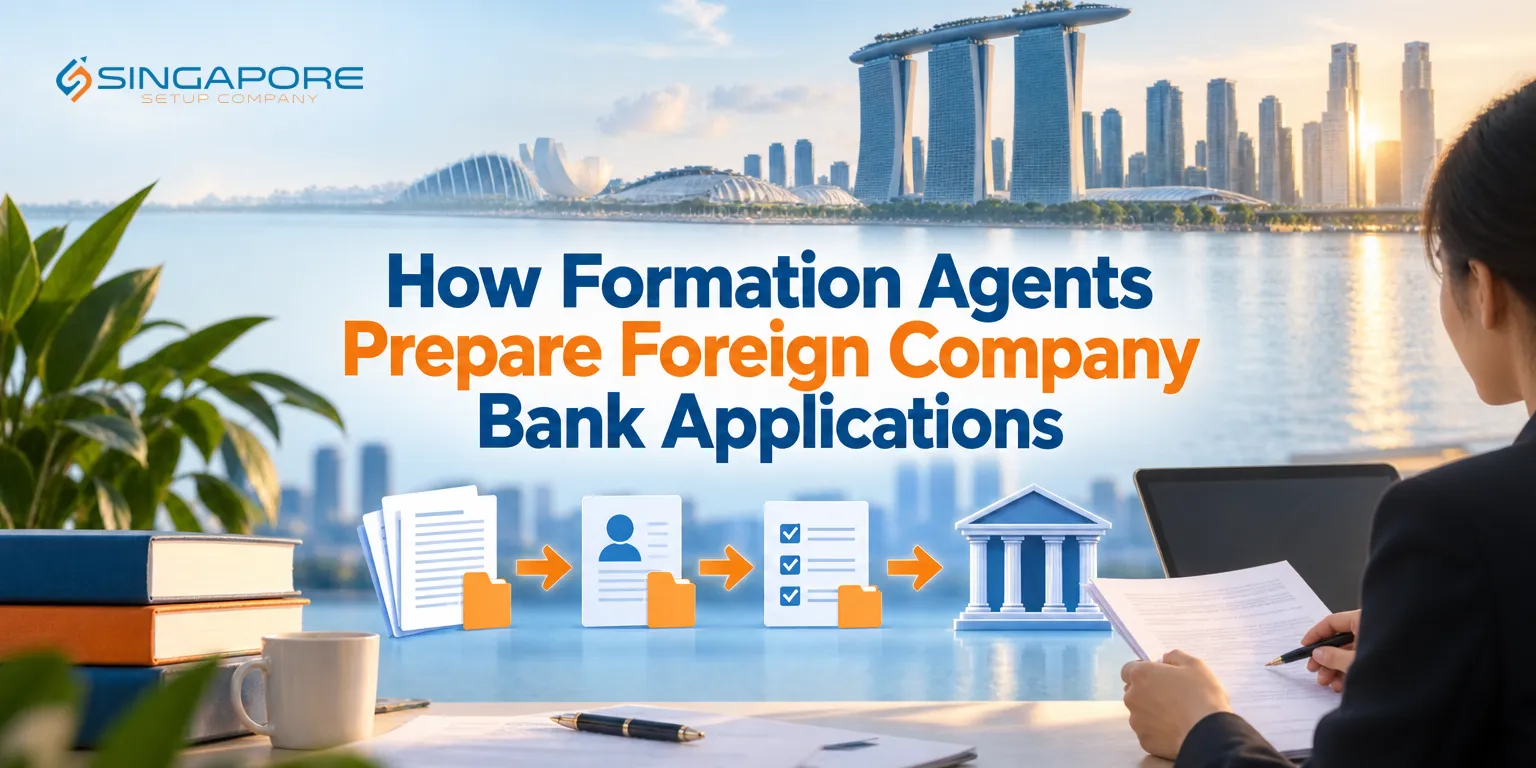
A formation agent prepares the full application file so the bank receives one coherent, verifiable package. The work usually happens in five stages, described below.
Step 1: Reviews your ownership structure
The agent maps your ownership chain up to every ultimate beneficial owner. Complex layers, nominee arrangements or trusts are flagged early. Fixing structure issues before applying prevents the most common cause of rejection.
Step 2: Prepares the KYC document file
The agent assembles identity documents, address proofs and corporate records for each director, shareholder and beneficial owner. Foreign documents may need certified translations or notarisation. The agent checks that every name, date and figure matches across the whole file.
Step 3: Drafts the business plan and source-of-funds narrative
Banks want a credible explanation of what the company will do and where its money comes from. The agent drafts a realistic business plan covering activities, customers, suppliers and expected transaction volumes. This narrative is tied to your ACRA-registered activities so nothing contradicts the official record.
Step 4: Shortlists suitable banks
Different banks have different risk appetites, customer profiles and document requirements. A formation agent matches your industry, nationality and ownership structure to the banks most likely to accept them. Applying to the wrong bank wastes weeks.
Step 5: Submits and follows up the application
The agent submits the file, tracks the review, and answers the bank's follow-up queries. They also coordinate interviews, video verifications or in-person signings for your directors. You can also speak with our team about your ownership setup before you commit to a bank shortlist.
Key ACRA Fees for a New Singapore Company in 2026
| Transaction | Fee (SGD) |
|---|---|
| Reserving a business name | 15 |
| Registering a local company | 300 |
| Filing annual returns | 60 |
| Extension of time to file accounts or hold an annual general meeting | 200 |
Why Prepare a Foreign-Owned Company's Bank Documents in Advance?
Banks ask foreign-owned companies for a fuller document set than local firms, and the exact list varies by bank. The core file, however, is broadly consistent across the market. Your formation agent's job is to have every item ready, consistent and verifiable before submission.
Which Structure Should a Foreign Company Choose Before Opening an Account?
The structure you register with ACRA shapes how the bank reviews you. Most foreign founders choose a local subsidiary because it is a separate Singapore legal entity with its own ACRA record. The differences between a branch office and a subsidiary also affect what the bank asks for, since a branch is legally an extension of the overseas parent.
A representative office sits at the other extreme: it cannot earn revenue, so its banking needs are limited to covering local expenses. Whichever you choose, keep in mind that ACRA requires a Singapore registered office address, open to the public for at least three hours each business day, plus at least one director meeting local residency rules.
Documents Banks Typically Request from Foreign-Owned Companies
| Document | What the bank verifies |
|---|---|
| Certificate of Incorporation and business profile | That the company exists and its details match the application |
| Company constitution | How the company is governed and who holds which powers |
| Passports and proof of address for directors | Identity and residence of every position holder |
| Corporate structure chart | The ownership chain up to each ultimate beneficial owner |
| Parent company documents | Where a foreign corporate shareholder sits behind the company |
| Board resolution and signatory list | Who is authorised to open and operate the account |
| Business plan and projected activity | Whether the stated activities fit the company's profile |
| Evidence of source of funds | Where the initial deposits and paid-up capital will come from |
What KYC and AML Checks Do Banks Apply to Foreign Shareholders?
Banks must identify and verify the ultimate beneficial owners of every corporate customer, screen them against sanctions lists, and apply enhanced checks to higher-risk situations. These obligations flow from MAS's anti-money laundering framework for Singapore's financial sector. For foreign shareholders, the practical result is a longer list of questions and evidence.
Most delays we see come from five recurring problems, all fixable before submission:
1. Undisclosed beneficial owners
Someone behind the ownership chain is hidden behind nominee shareholders or a trust. Banks treat this as a red flag and may decline outright. Agents surface and document every beneficial owner from the start.
2. Unclear source of funds
The deposit money comes from a source the bank cannot trace, such as an unexplained personal account. Agents prepare documentary evidence linking funds to a legible origin.
3. Inconsistent company details
Names, addresses or shareholdings differ slightly between the ACRA record, the constitution and the application. Each mismatch triggers another round of bank queries. A careful pre-submission check removes them.
4. A thin or generic business plan
The plan reads like a template with no real customers, activities or projections. Banks want a plausible explanation of expected transactions, tailored to your actual business.
5. Signatories unprepared for verification
Directors cannot answer basic questions about the company during the bank's call. Agents brief every signatory beforehand so the interview confirms, rather than contradicts, the file.
What Determines How Long Corporate Account Opening Takes?
There is no fixed published timeline; the duration depends mainly on how complex your ownership chain is and how complete your file is. Several factors shape the calendar:
Factors that affect processing time include:
- The number of jurisdictions in your ownership chain
- Whether documents need notarisation, translation or apostilles
- The bank's current workload and the account type you chose
- How quickly you answer follow-up queries
- Whether verification requires an in-person visit or video call
How Banks Usually Treat Each Foreign Company Structure
| Structure | Typical bank treatment | Best suited for |
|---|---|---|
| Local subsidiary | A separate Singapore entity; usually the smoothest review | Most foreign owners trading from Singapore |
| Branch office | An extension of the foreign parent; the parent faces closer scrutiny | Companies extending an existing overseas business |
| Representative office | Cannot earn revenue; banking limited to local expenses | Market research and liaison activities only |
What Happens After Your Corporate Account Is Approved?
Approval is not the end of the relationship; banks periodically refresh their customer records. Your account file must stay consistent with your ACRA records as the company changes. Tell your banker when directors, shareholders or business activities change, so the file never drifts out of date.
Compliance deadlines follow quickly. ACRA charges S$60 to file your annual return under its 2026 fee schedule, with a S$200 fee if you need an extension of time. Separately, the Inland Revenue Authority of Singapore (IRAS) requires companies to file their Corporate Income Tax Return by 30 November 2026 for the Year of Assessment 2026, at the prevailing 17% corporate tax rate on chargeable income.
Even dormant companies need attention: IRAS lets qualifying inactive companies file a simplified dormant form, while smaller active companies often qualify for Form C-S. Handling the handover of your accounting and tax records alongside your annual return filing keeps the banking file, ACRA record and tax filings aligned — which is exactly what a bank reviewer likes to see.
Conclusion
Getting a foreign-owned company banked in Singapore comes down to preparation: a clean ownership structure, a consistent KYC file, a credible business plan and the right bank choice. ACRA handles the incorporation quickly; the bank's review is where a well-prepared file separates a smooth opening from weeks of back-and-forth.
Singapore Setup Company guides local and foreign founders through this whole journey. With over ten years of experience, we handle incorporation with ACRA and provide corporate secretarial, compliance and accounting support afterwards. That means your company records, filings and banking file stay aligned year after year.
If you are preparing a foreign company bank application and want help with your company's Singapore bank account, our team is ready to assist you.
Ready to Get Your Foreign Company Banked in Singapore?
Let our formation specialists prepare your ownership file, KYC documents and bank applications so nothing is left to chance.
Frequently Asked Questions
No. Approval decisions rest entirely with the bank. A formation agent's role is to prepare a complete, consistent and credible application so your file is as strong as possible.
It depends on the bank. Some accept video verification for directors, while others require an in-person signing. Your formation agent will confirm each bank's current requirements before you apply.
No. Banks require an ACRA-registered entity with a Unique Entity Number before a corporate account can be opened. Incorporation always comes first.
Accepted evidence varies by bank but commonly includes audited financial statements, sale agreements, salary records or dividend statements. The documents must clearly connect your funds to a legible origin.
A decline is not final. Ask the bank for the reasons, address the gaps, and apply to a bank better suited to your profile. A formation agent helps you correct the file and choose the next bank wisely.

Singapore Setup Company
Author
Singapore Setup Company is a Singapore corporate services provider that guides local and foreign entrepreneurs through setting up and running a company in Singapore.